If you’re carrying new weight around your middle since menopause and looking for the foods that will shift it, there’s something worth knowing before you start cutting things out: menopause belly fat responds far better to what you build your meals around than to what you take away. The women who make progress with it rarely do so by eating less – they do it by eating differently.
Category
Hormonal Health
Why Am I Still Gaining Weight After Menopause?
You did the hard part. Your periods have stopped, the hot flushes may have settled, and you expected your body to find some equilibrium at last. Instead, the weight is still creeping up – often faster than before, and stubbornly around your middle – and no one warned you it would keep happening after menopause, not just during it.
Does HRT Cause Weight Gain? What the Evidence Actually Says
If you’re considering HRT – or already taking it – and you’re worried it will make you gain weight, you’re in very good company. Fear of weight gain is one of the most common reasons women hesitate over hormone therapy, or stop taking it. It’s also, according to the evidence, largely misplaced.
Your Blood Tests Came Back “Normal” but You Still Feel Awful – Here’s Why
You did everything right. You noticed you weren’t feeling like yourself – tired, foggy, gaining weight, just off – so you booked the blood test, fasted, showed up, and waited. Then came the call: “Everything’s come back normal. You’re fine.”
If your blood tests are “normal” but you feel anything but, there is almost always a real, identifiable reason – and understanding it is the first step to doing something about it. The problem usually isn’t that nothing is wrong. It’s that the standard tests weren’t designed to find what’s actually happening.

Perimenopause and Mood: Why You Feel Different – and What’s Actually Happening
If you have started feeling like a different person in your 40s – more irritable, more tearful, more flat, more reactive, less resilient, less recognisable to yourself – and you cannot fully explain why, this article is for you.
The mood changes of perimenopause are one of the least discussed and most disorienting aspects of this transition. Women describe feeling unfamiliar to themselves. Crying without obvious reason. Snapping at people they love. Losing pleasure in things that used to bring joy. Feeling flat where they used to feel engaged. Experiencing rage that surprises them. Carrying a low-grade sadness that does not quite reach the threshold of depression but does not lift either.
Most of these experiences are dismissed – by doctors, by family, by women themselves – as stress, midlife crisis, hormonal moodiness, or simply the demands of a busy life.
Perimenopause and Anxiety: The Hormonal Connection Most Women Don’t Know About
If anxiety has appeared in your 40s – or significantly intensified after years of being relatively manageable – and you cannot point to anything in your life that fully explains it, you are not alone, and you are not imagining it. This is one of the most common and most distressing experiences of perimenopause.
Perimenopause and Cortisol: Why Stress Hits Harder in Your 40s
If you have noticed that stress hits you harder than it used to – that small things tip you over more easily, that you feel less resilient, that the recovery from a difficult day takes longer than it should – you are not imagining it. This is one of the most common experiences of perimenopause, and one of the least adequately explained.
What Is Perimenopause? Symptoms, Timeline, and What to Expect
For many women, perimenopause does not announce itself clearly. It creeps in quietly – a sleep pattern that shifts, a mood that feels harder to manage, a waistline that stops responding the way it used to, periods that become unpredictable after years of reliability.
Why Do So Many Women With PCOS Also Have Hashimoto’s?
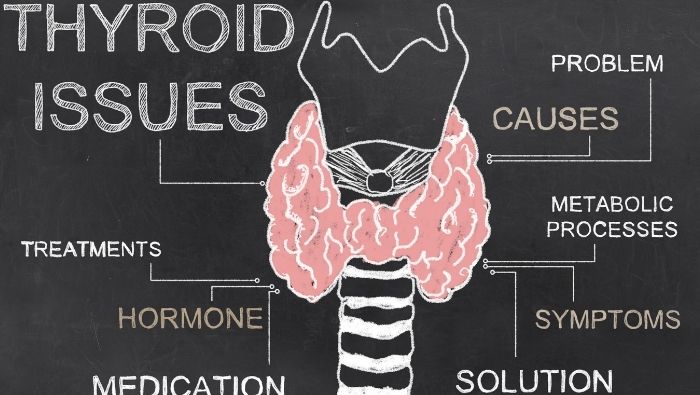
If you have PCOS and you’ve also been diagnosed with an underactive thyroid – or Hashimoto’s specifically – you might have assumed it was bad luck to have two separate conditions at once. It usually isn’t. PCOS and thyroid problems overlap far more often than chance would predict, and there’s a real, identifiable reason why.
PCOS and Anxiety: The Hormonal Connection Most Women Don’t Know About
Anxiety is one of the most common but least-discussed PCOS symptoms. Here’s why PCOS causes anxiety at a physiological level – and what addressing the metabolic root actually does for your mental health.
PCOS and Irregular Periods: What Your Cycle Is Really Telling You
For many women, an irregular or absent period is the first sign that something is wrong – the symptom that eventually leads to a PCOS diagnosis. And yet, once that diagnosis is made, the explanation often stops there.
“Irregular periods are part of PCOS.” Full stop.
What is rarely explained is why PCOS disrupts the menstrual cycle, what is happening hormonally during those long, unpredictable cycles, what it means metabolically when ovulation is absent, and – most importantly – what actually happens to cycle regularity when the underlying metabolic drivers are addressed.
PCOS After 40: When PCOS and Perimenopause Start to Overlap
Introduction If you have been managing PCOS for years - understanding your body, learning your...